
Stan’s Beaver Baffler device is recommended instead of flow pipe devices because:
- Flow pipe devices are difficult to install in deep water utilizing long 20–40-foot pipes with remote water intakes. They also constrict or totally block fish/wildlife passage.
- SBB is easily installed in shallow water using livestock panels and provides fish/wildlife passage.
Five Key Features of the SBB work together to create a device that is easy to install and provides fish/wildlife passage.
- How – an elongated lane fence (12-24 foot long and 3-4 foot wide) is oriented upstream.
- How – the device is installed in shallow water (1-2 feet).
- How – an integral skirt (8-14”) is incorporated as part of the lane fence device.
- How – materials needed are readily available, livestock panels, steel T-posts, and T-post fence clips or rebar wire.
- How – fish/wildlife passage is provided for both culvert and pond leveler versions.
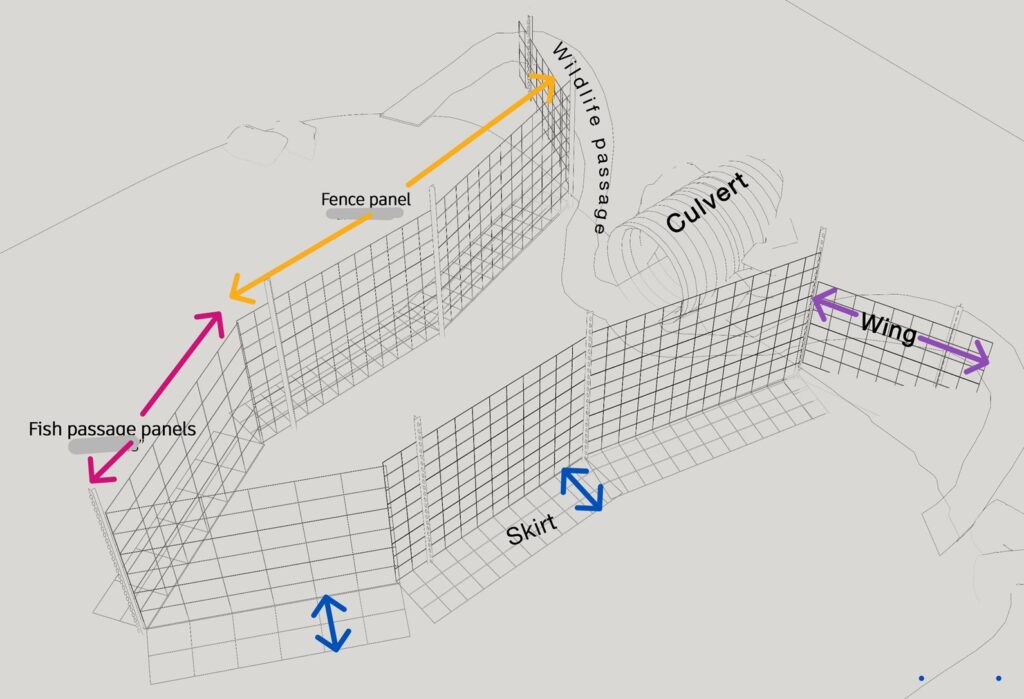
- Culvert version – Incorporates short 2–4-foot wings on both sides of the culvert.
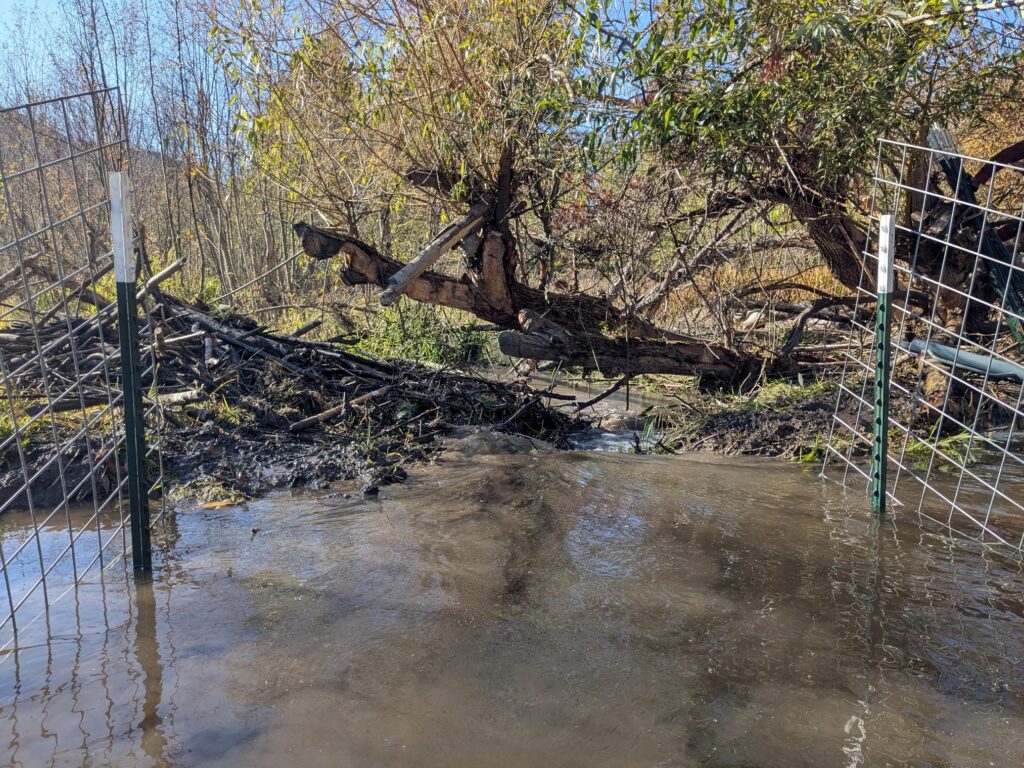
- Pond leveler version – Extends the lane fence past the dam notch a short distance (1-2 feet) and leaves the lower downstream end of the device open.
- Why – an elongated lane fence (12-24 foot long and 3-4 foot wide) is oriented upstream.
- Why – the device is installed in shallow water (1-2 feet).
- Why – an integral skirt (8-14”) is incorporated as part of the lane fence device.
- Why – materials needed are readily available, livestock panels, steel T-posts, and T-post fence clips or rebar wire.
- Why – Fish/wildlife passage is provided for both culvert and pond leveler versions.
- Culvert version – Incorporates short 2–4-foot wings on both sides of the culvert.
- Pond leveler version – Extends the lane fence past the dam notch a short distance (1-2 feet) and leaves the lower downstream end of the device open.

Feature 1. Elongated Lane Fence
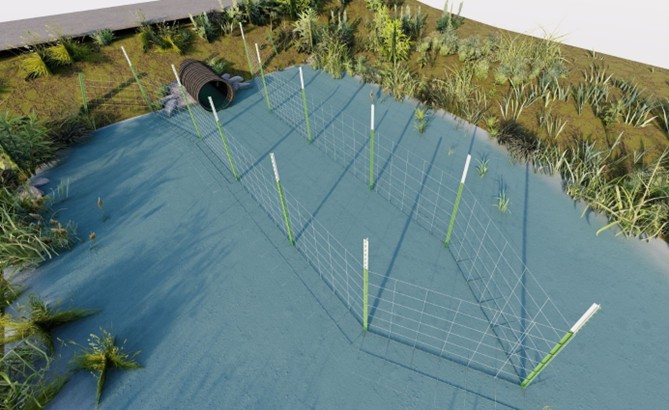
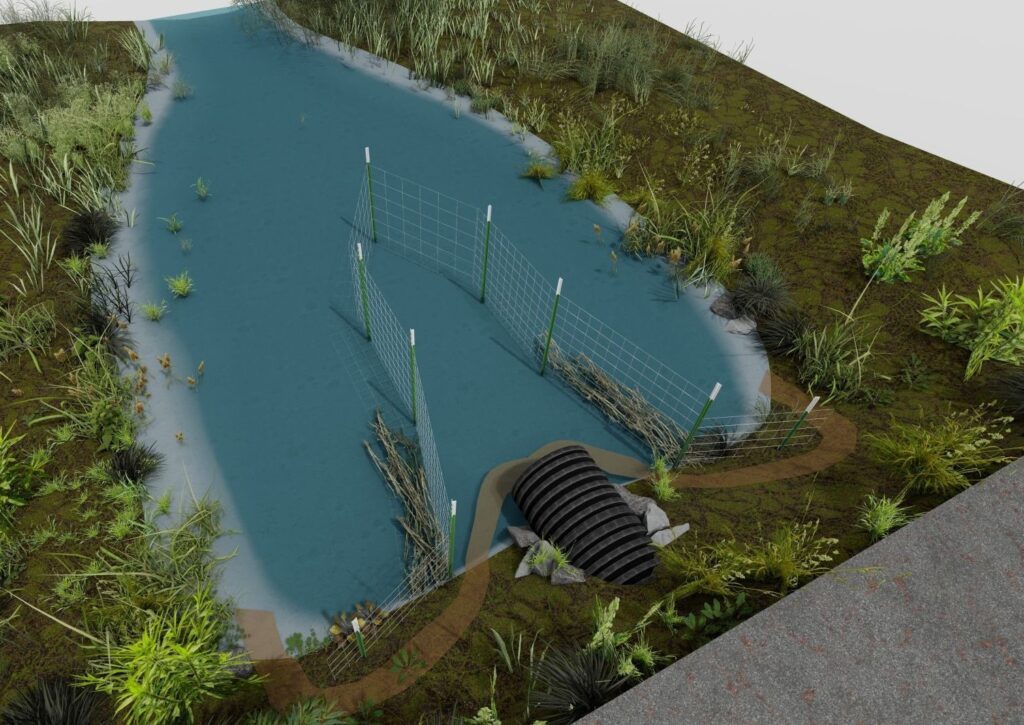
How-A simple lane fence is oriented upstream. The structure is 3-4 feet between the fences with a length of 12-24 feet. The elongated lane fence is also pointed at the upper end.
Why an elongated fence is explained. link
Feature 2. Install SBB in Shallow Water.
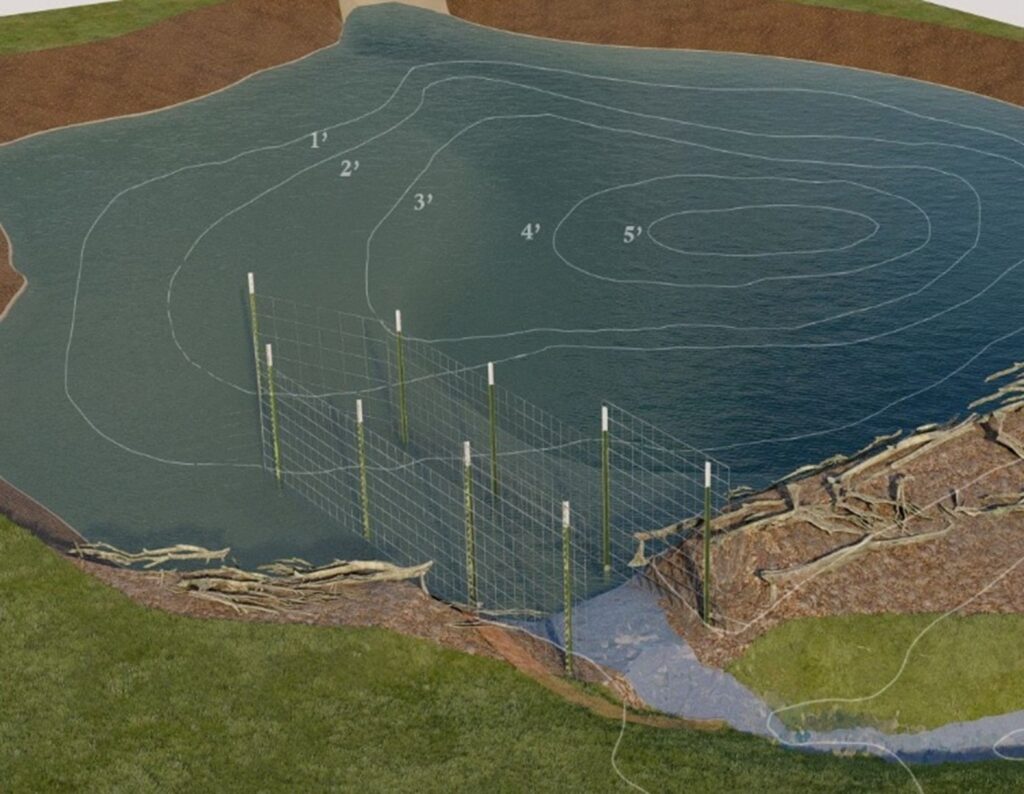
How– When there is a choice, install the lane fence in water that is 1-2 feet deep. The lane fence does not need to be built in a straight line, it can be curved or angled to follow a stream channel, or near the shore of a beaver pond to take advantage of shallow water.
Why install in shallow water is explained.link
Feature 3. Incorporate an Integral Skirt
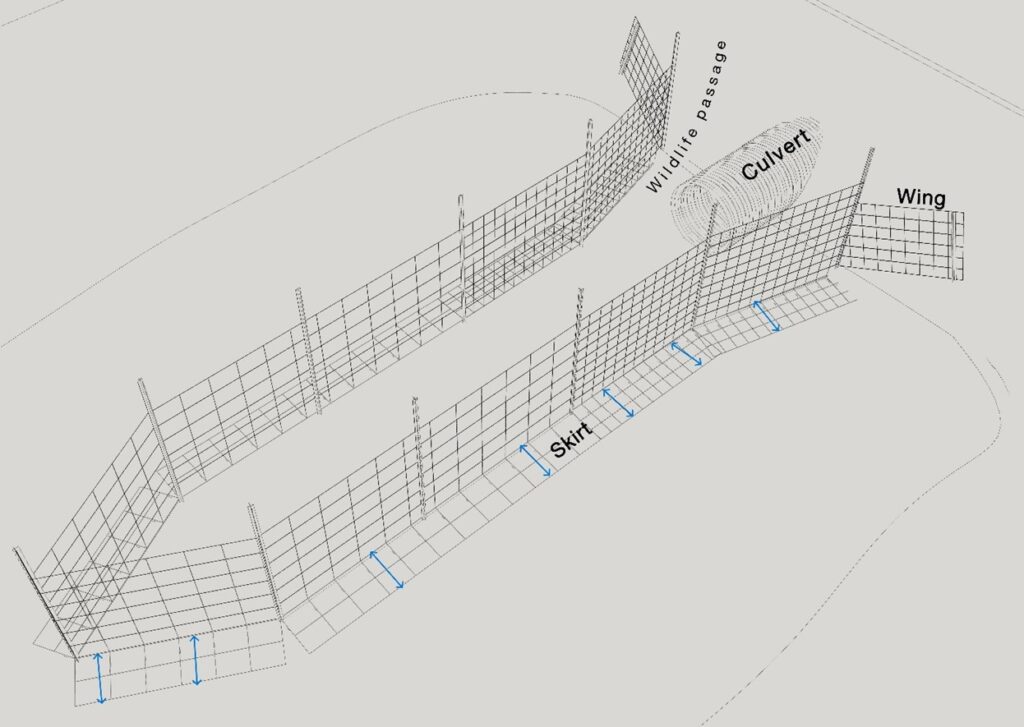
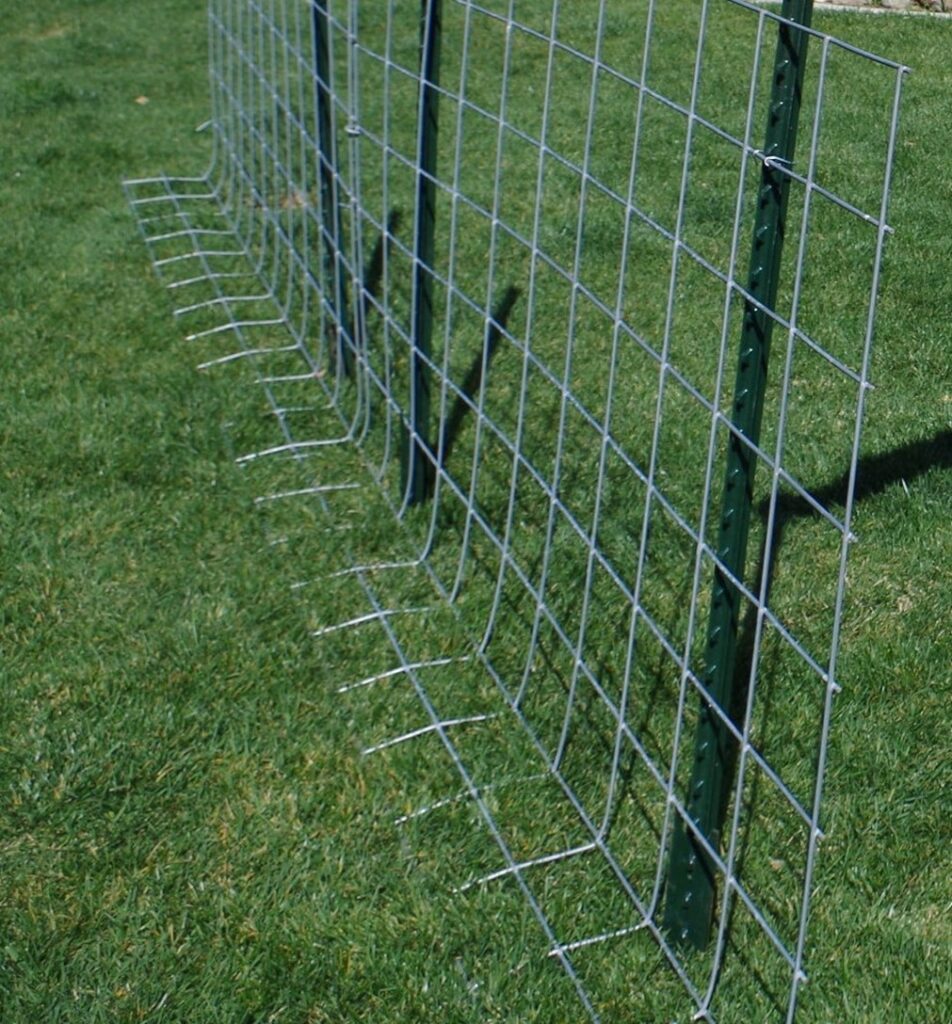
How-Create an integral skirt on the outside of the lane fence. The skirt is created by bending a 4-foot panel into a 12-14 inch skirt and 3-foot high fence.
Why create an integral skirt is explained. link
Feature 4. Materials and Tools Needed.
How – Simple is better, that is a key philosophy of Stan’s Beaver Baffler. Materials and tools needed are readily available. The SBB is designed for easy installation.
Materials needed for construction.
Materials needed for a Stan’s Beaver Baffler include only 3 items.
- Livestock panels or concrete reinforcement mesh with grids of 6”x8”, 6”x6”, or 4”x4”.
- Steel T-posts 5.5’-foot 1.25lbs/foot type
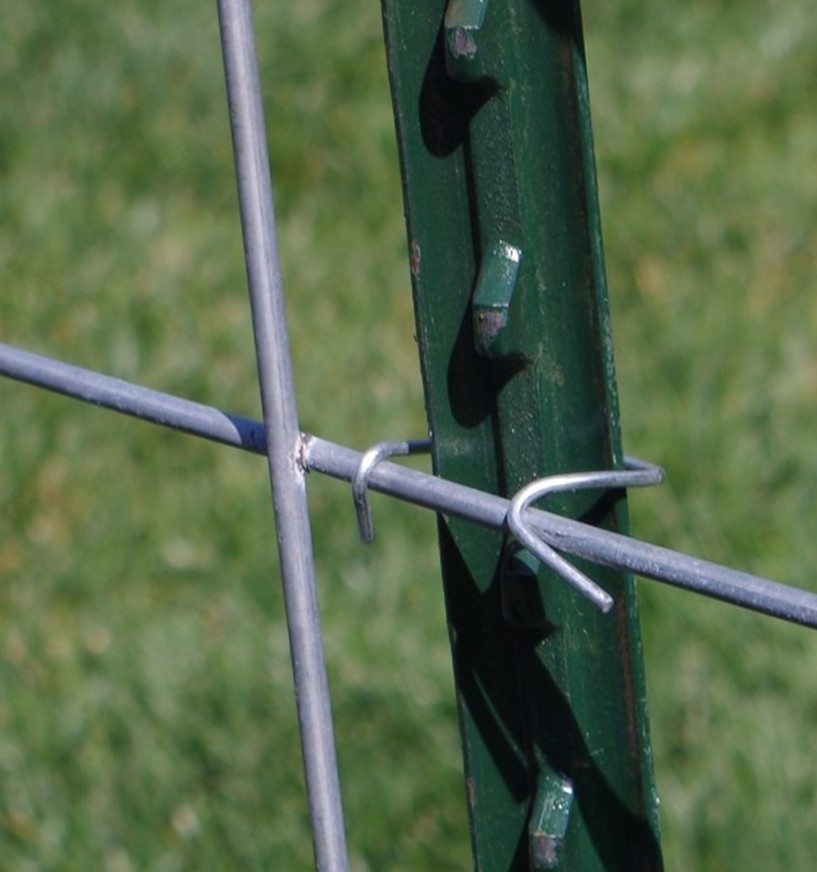
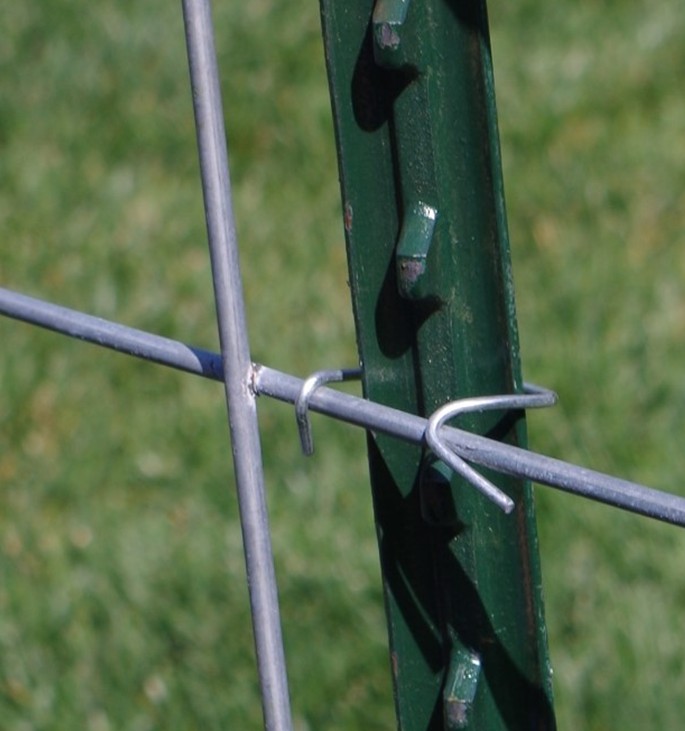
- Fence clips, 11-gauge chain-link T-post clips or rebar wire ties.
Materials cost for a typical 12’-24’ SBB structure is $250-$350.
Why these 3 materials are all that is needed for a Stan’s Beaver Baffler. link
Tools Needed for Installation
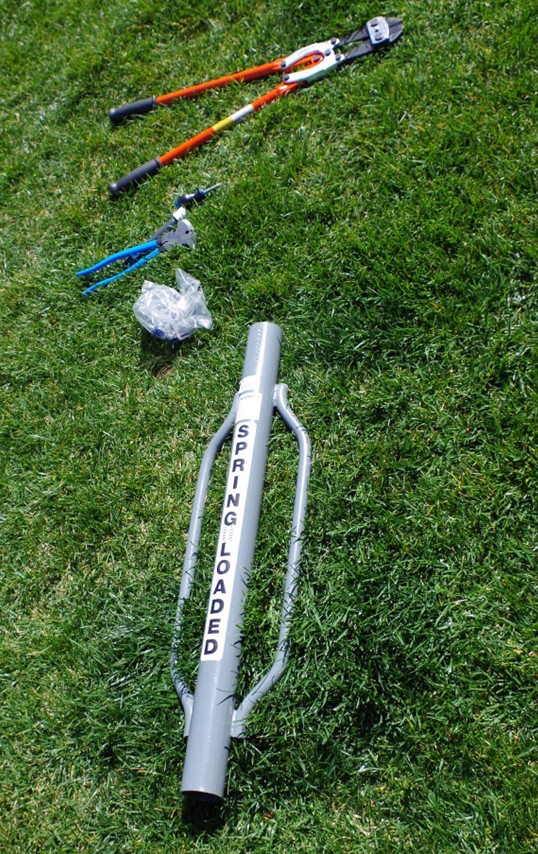
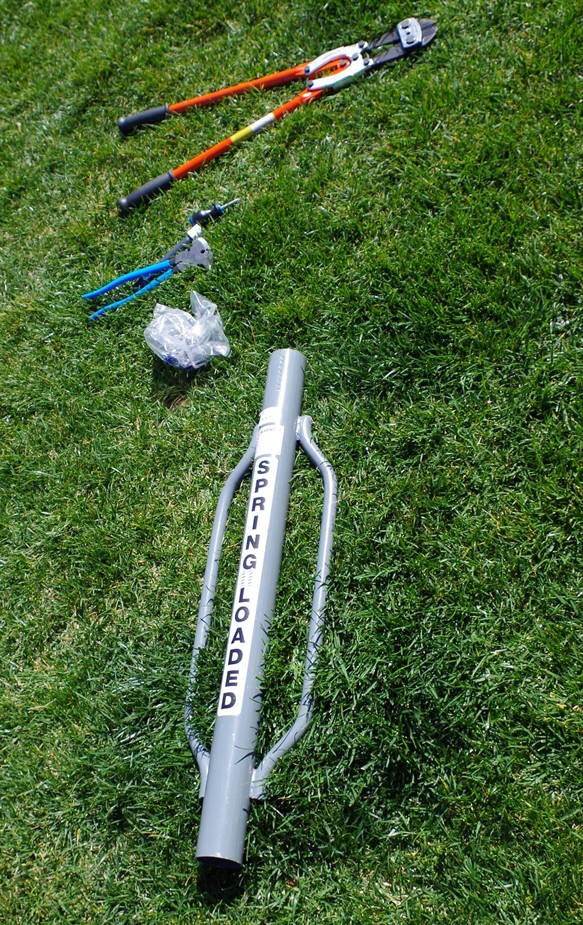
Tools needed to install a SBB include only 4 items.
- Medium 24” bolt cutters
- Fencing pliers
- T-Post Driver
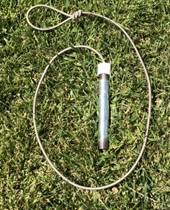
- Custom wire bender
Why these 4 tools are all that is needed to install a Stan’s Beaver Baffler? link
1
Feature 5. Fish/Wildlife Passage
The first four features of the Stan’s Beaver Baffler are the same for protecting both road culverts and pond leveler dam notches. Culverts and beaver dams are very different structures that require different approaches for providing Fish/Wildlife passage while resolving beaver conflicts.
A SBB provides fish/wildlife passage. Flow pipes constrict or block fish passage. Culvert fence installations that block beaver access to the culvert also block passage through a culvert.
Culvert protection version of SBB
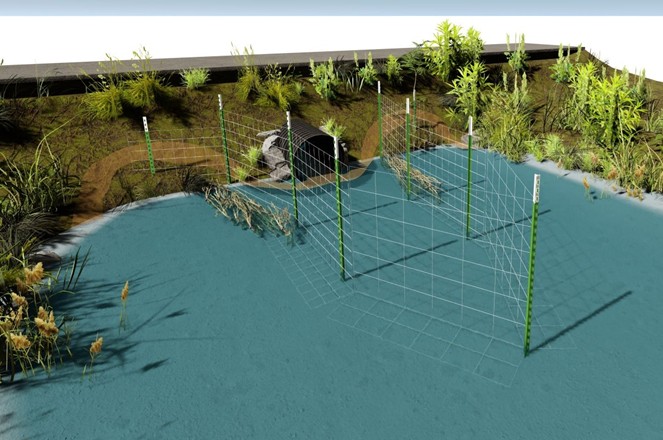
How- Wildlife passage is provided by short 3–4-foot wings on both sides of the culvert. Fish passage is accommodated by installing upstream water intake panels with a grid appropriate for the size of fish using the stream.
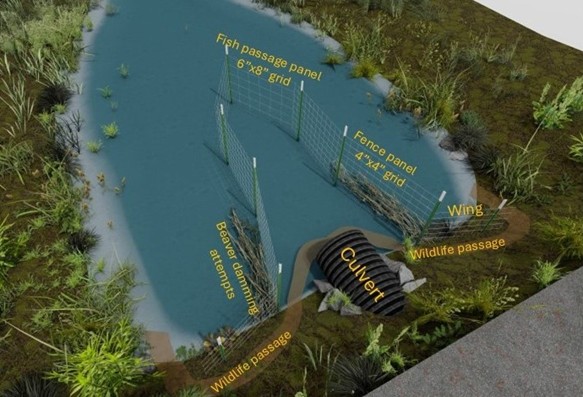
Why fence wings and appropriate panel grid size provide safe Fish/Wildlife passage. link
Pond leveler protection version of SBB
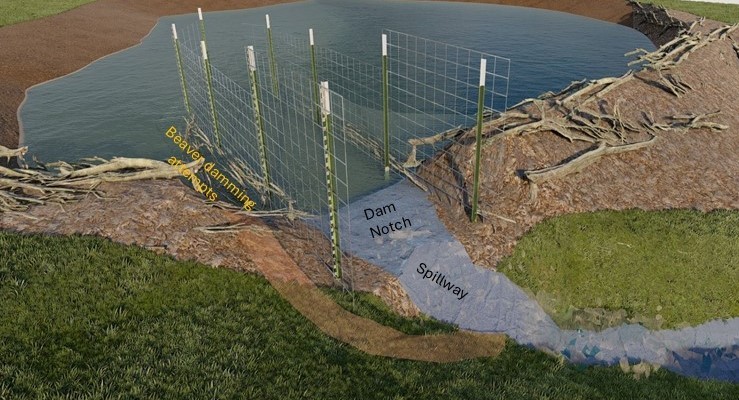
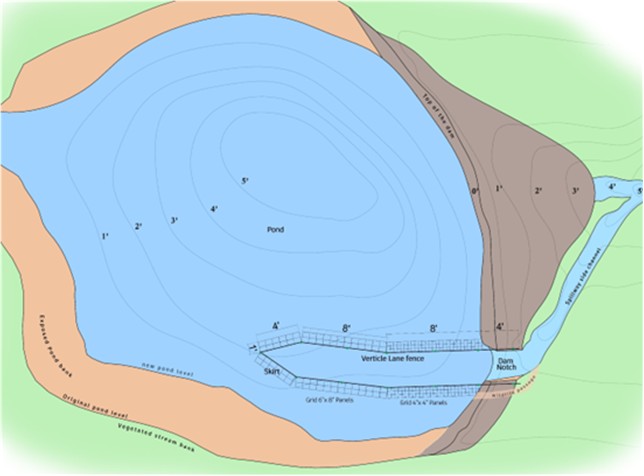
How– Fish passage is provided by including a 3-4-foot-wide dam notch that is protected with a lane fence. The fence is extended past the dam notch a short distance. The lower end is left open where the dam notch transitions into a spillway and side channel.
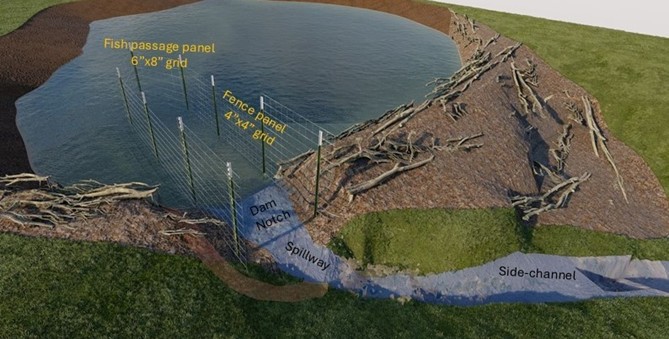
Why dam notch protection fence and appropriate panel grid size provides fish passage. link
Why Stan’s Beaver Bafflers (SBB) solve beaver conflicts while accommodating fish and wildlife passage.
Beaver Deceivers™ and Keystone fences™ are designed with a focus on what beavers do. They do sometimes build a dam that plugs a culvert or build a dam that floods infrastructure.
- The culvert plugging Beaver Deceiver solution protects the culvert by excluding beavers and blocking their access to the culvert.
- The flexible pipe pond leveling solution for protecting a dam notch is to install a long 20-40 foot flow-pipe with a remote deep water intake.
- Both solutions tend to constrict or block fish/wildlife passage through the culvert or dam notch.
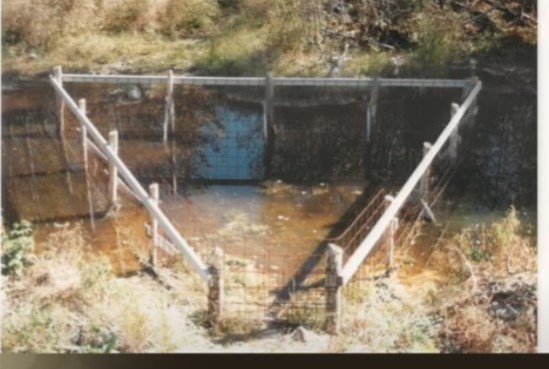
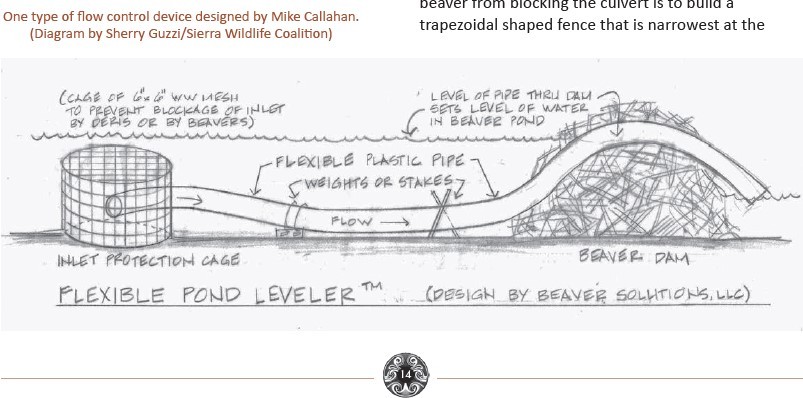
The Stan’s Beaver Baffler (SBB) approach is to focus on what beavers avoid doing instead of what they do. Then install a structure that creates an undesirable site for dam building while providing fish/wildlife passage.
- Culverts are used on a routine basis by beavers to travel safely under roads. Beavers will build a dam on a culvert if it becomes a desirable site when debris creates a starter dam. An SBB installation with small wings will discourage beaver from rebuilding on the culvert.
- Pond leveler solution for protecting a dam notch is to install a lane fence in shallow water, then extended the fence through a dam notch to the spillway. Beavers avoid building and repairing the downstream side of their dam. They will also avoid dam building in fast flowing water that flows out of the lane fence into the spillway.
- c. Both Culvert and Pond leveler versions of the SBB accommodate fish/wildlife passage.
Feature 1. Why an Elongated Lane Fence?
Orientation
The upstream orientation of a lane fence discourages beavers from building a dam because instinctively they build their dam across a stream and not up a stream. They seldom attempt to build more than 4-6 feet upstream along a lane fence and never build all the way around it when the fence is 16-24 feet long.
Width of the structure should be 3-4-feet between the fence panels. Beaver are more likely to attempt blocking water flow by poking sticks and mud through a lane fence that is only 2-feet wide. When beavers poke sticks through both sides of a 2-foot lane fence there is a good chance the sticks will obstruct water flow as debris accumulates. When doing maintenance there is no need to remove sticks poked through the fence. It is preferable to prune the sticks poked through leaving 2”-3” stubs within the lane as they will not interfere with water flow They will also prevent additional material being poked through.
Length of the structure will vary based on site conditions.
A smaller 12-foot fence may be adequate if the dam and pond is newly built, less than 1-year. In this case it may be a lone dispersing beaver that has started a small, but potentially problematic, dam in front of a partially plugged culvert. If the stream is shallow or ephemeral after the culvert has been unplugged and no pond remains, a 12-foot lane fence is adequate. The small 12-foot fence will also serve as a trash rack and deterrent that prevents future debris from blocking the culvert entrance. Dispersing juvenile beavers are not likely to build a new dam at the culvert site if there is no debris caused starter dam in front of the culvert.
A larger 16-24-foot fence will be needed to protect a dam notch or culvert when a beaver dam has existed for several years and a breeding colony is well established.
Feature 2. Why install SBB in Shallow Water?
Shallow water installation of a SBB pond leveler has several advantages when compared to the typical deep-water flow-pipe installation.
- Water depth of 1-2 feet facilitates installation.
- Locate the dam notch where the pond depth will be approximately 1-foot deep after the dam notch is created.
- Utilize existing side channels for the spillway when available.
- Extend the lane fence into 2-2.5 feet of water when feasible as some studies indicate that beaver seldom build along fences where water is already 2-feet deep
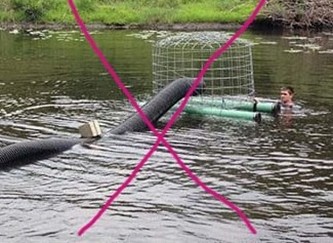
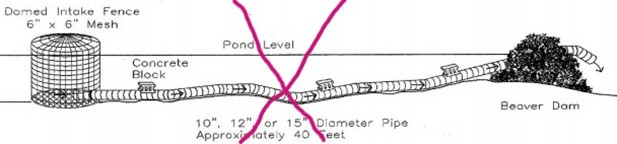
Flow pipe devices with water intakes in the deepest part of a pond can be moderately to very difficult installations. A flow-pipe will also constrict or block fish passage.
Feature 3. Why create an Inetgral Skirt?
Beavers are instinctively expert diggers, burrowing to create their lodge. Beavers will typically attempt to start their burrow adjacent to the fence.
Integral skirts are effective at discouraging beaver from digging under the fence.
- Because the skirt blocks the beaver’s effort at starting a tunnel adjacent to the fence they will usually give up.
- The integral skirt also increases the rigidity of the fence and assists in holding the fence to the bottom of the pond.
- Integral skirt can be easily created as part of the fence when being installed.
- The integral skirt utilizes no additional material if the fence is installed in shallow water and a 4-foot panel is used to create the 1-foot skirt and a 3-foot fence.
Separate skirt Sherri Tippi in Colorado added skirts to many of the Beaver Deceivers she installed under the guidance of Skip Lisle in the early 2000’s. Beaver occasionally dug under a fence without a skirt. She found that adding a 1-foot skirt when needed solved the problem. The added skirt includes spikes which use more material than the integral skirt
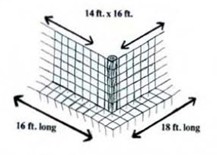
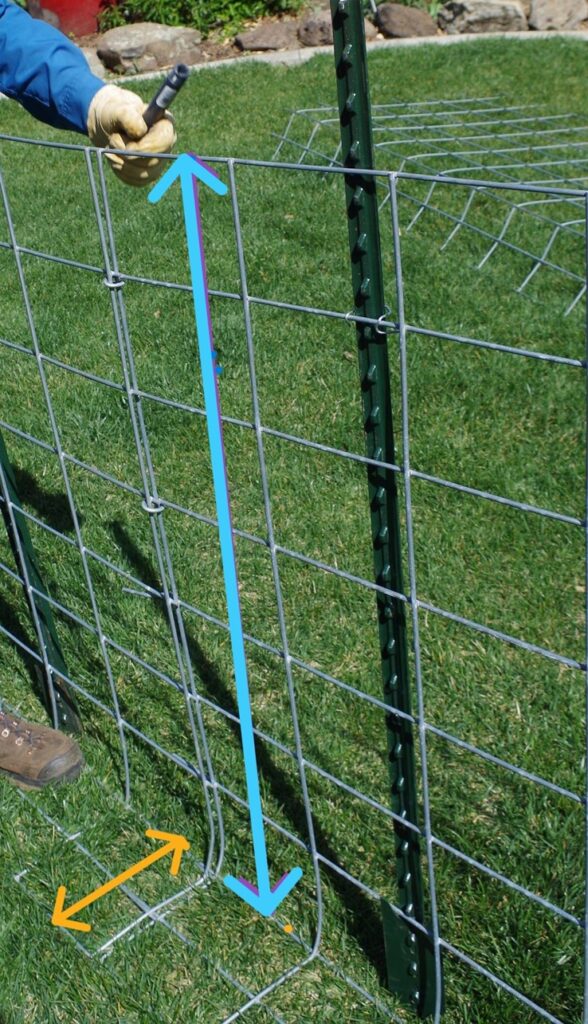
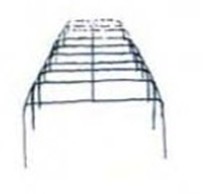
Full Floor Fence. Creating a full floor fence prevents beaver from digging under the fence. The cost in time and materials is more than the integral skirt.
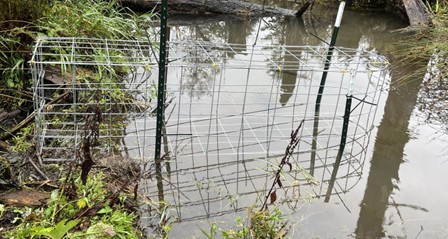
Feature 4. Materials – Why are only 3 materials needed?
Simple is better, a key philosophy of Stan’s Beaver Baffler.
Note: No pipes, screens, hammers, nails, bolts, staples, screws, boards, connectors, concrete blocks, floats, step ladders, sledgehammers, or power tools are required to install a Stan’s Beaver Baffler.
Why-The SBB is designed to function with a minimum of materials to assemble and install. The three items needed to create and install a Stan’s Beaver Baffler are readily available at numerous farm supply stores.
- Fence materials are galvanized welded wire livestock panels or ungalvanized concrete reinforcement mesh. The type of mesh used for the fence will depend on availability and site-specific needs for fish and wildlife passage.
- 6×6 inch mesh welded 6-gauge ungalvanized concrete reinforcement.
- This mesh size is effective at stopping beavers and allows small and moderate size fish to pass through. Small juvenile beavers may occasionally pass through a 6”x6” mesh fence. Available as concrete reinforcement mesh and is ungalvanized. Commonly available as large panels 4’x16’ and can be cut to 4’x8’ for transporting and installing. Sometimes available are smaller panels with epoxy coatings. Available at metals supply and other industrial metal outlets.
- 6×8 inch mesh welded 6-gauge galvanized wire livestock panels.
- The larger 6×8-inch mesh size is recommended for sites with large fish such as Coho salmon or locations with large turtles. Juvenile beaver may occasionally pass through the panels, however the young beaver may not be effective at rebuilding a plugged culvert or dam notch. These panels have vertical 4 gauge wires and horizontal 6 gauge wires. Commonly available as 4’x16’ livestock panels and can be cut to 4’x8’ for transporting and installation. Available at Tractor Supply and other farm supply outlets.
- 4×4 inch mesh welded 4-gauge galvanized wire livestock panels.
- This mesh size is effective at stopping beaver and allows small and moderate size fish to pass through. Small juvenile beaver will also be excluded. These panels are strong and very resistant to fence collapsing or rusting. Commonly available as 4’x16’ or 5’x16’ livestock panels and can be cut to 4’x8’ for transporting and installation.
- The 4×4 inch mesh grid livestock panels can be used to create an 8-foot panel section that discourages beaver next to a culvert or dam notch. The larger 6×8-inch mesh grid panels is used for the upstream portion of a structure to provide large fish and turtle passage. Available at Tractor Supply and other farm supply outlets.
- Steel 5.5-foot T-posts are utilized to support the Stan’s Beaver Baffler lane fence. The 5.5-foot T-post provides 30-inches into a pond bottom with 3-feet above the pond floor, adequate for a 3-foot fence panel. Beaver Deceivers™ utilize wooden posts for installation while Keystone fences™ and Flexible Pond Levelers™ utilize steel T-posts. The steel T-post does not deteriorate over time. Wooden posts are difficult and can be unsafe to install as they need a ladder and sledgehammer to install. Available at Tractor Supply and other farm supply outlets.
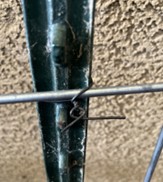
- Cyclone fence T-post clips 11-gauge are utilized to attach welded wire panels to the T-posts. Makes a very strong connection. Use 2-3 clips per post. Standard wire fence clips for T-posts are designed for barbed or smooth wire that is somewhat flexible and do not work to connect stiff livestock panels. Cyclone fence T-post clips, 11 gauge, are available online at Amazon. Twisted rebar wire is commonly used to connect panels to T-posts, rebar wire is not as strong and more difficult to use. Zip ties should not be used as they will deteriorate within 2-3 years.
Feature 4. Tools – Why are only 4 Tools needed?
Simple is better, a key philosophy of the Stan’s Beaver Baffler
Note: No pipes, screens, hammers, nails, bolts, staples, screws, boards, connectors, concrete blocks, floats, step ladders, sledgehammers, or power tools are required to install a Stan’s Beaver Baffler.
Why – Easy to install is a key feature incorporated into the Stan’s Beaver Baffler. Simple design reduces complexity and need for numerous tools.
Four tools needed to install a SBB device.
- – Medium 24” bolt cutters — Inexpensive 18” bolt cutters will work, however, medium grade made in USA 24” bolt cutters make the job a lot easier. Cost $25-$65.
- – Fencing pliers — $15-$28. Best to get the better quality made in USA.
- – T-Post Driver —Cost $40-$100. Much safer and easier than using a sledgehammer.
- – Custom wire bender — The wire bender is used to bend wire prongs when connecting panels together. You need to make it yourself using a 6” long ½” galvanized pipe nipple with a pvc cap on one end. Drill a hole in the cap and attach a lanyard so if you drop it in the beaver pond you can find it again. Cost $4.
Feature 5 – Why culvert version of SBB provides Fish/Wildlife Passage
Problem: Fish/wildlife passage can be constricted or blocked by fences and flow-pipe devices that are attached tightly to a culvert when excluding beaver access.
Solution: Fish/wildlife passage is provided by two features incorporated into the culvert version of a SBB, wings and right-sized livestock panels.
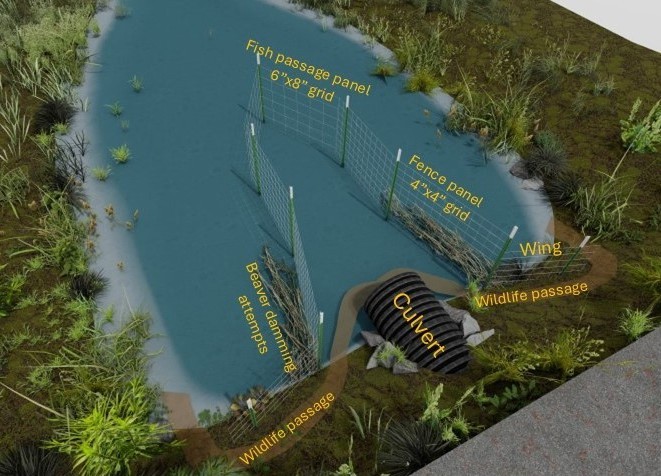
Problems related to fish/wildlife passage being constricted or blocked by flow-pipes are resolved by incorporating two features into the SBB culvert version.
- Small wings discourage beaver from building against the culvert while allowing beaver and turtles to pass through the culvert and travel around the wings.
- Beavers instinctively drag food and dam building material into their pond. They also instinctively add material to the top edge of their dam at water level, sometimes poking and pushing branches over the edge of their dam.
- Beavers instinctively avoid dragging dam building material out of a pond, up a bank, around a wing barrier and back down again. Dragging material out of the pond and up a bank is instinctively a bad idea as that is where the predators are and also will not increase the height of their dam. There is one specific exception, beavers do drag material out of the water to increase the height of their lodges, both in the pond and bank lodges.
- Fish passage panels of the SBB utilize livestock panels that accommodate fish that will be using the stream. The 4”x4” grid can accommodate small and medium size fish. 6”x8” panels are utilized for streams that have larger anadromous salmon.
- Small fish are able to migrate downstream through the culvert because water flows unobstructed through the SBB lane fence into the culvert.
- Adult fish migrating upstream to spawn are able to exit the culvert and pass through the upper end of the SBB without being blocked by a culvert screen or flow pipe device.
- Debris will tend to accumulate against the 4”x4” fence panel near the culvert while the upstream fish passage panels will continue to provide water flow into and through the SBB.
- The frequency of debris removal depends on the debris flow in the stream or pond.
Examples of installations that protect culverts utilizing wing fences and livestock panels to accommodate fish/wildlife passage.
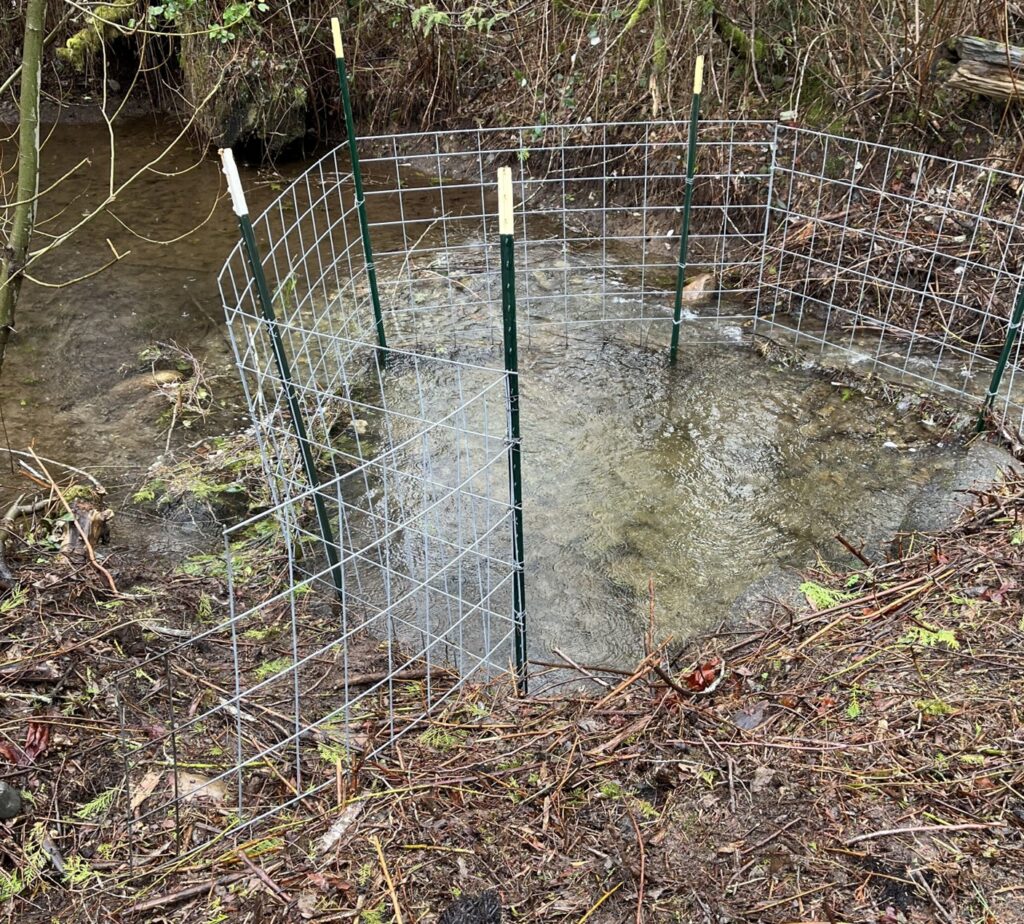
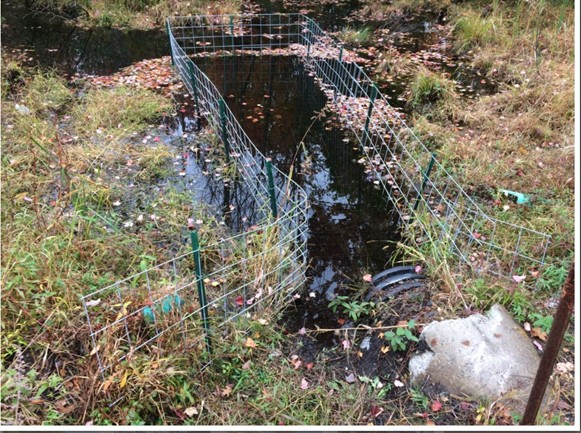
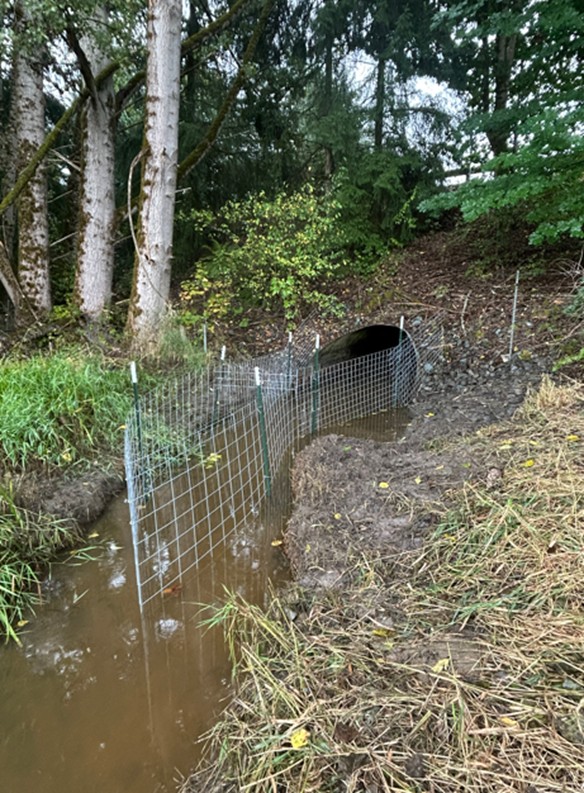
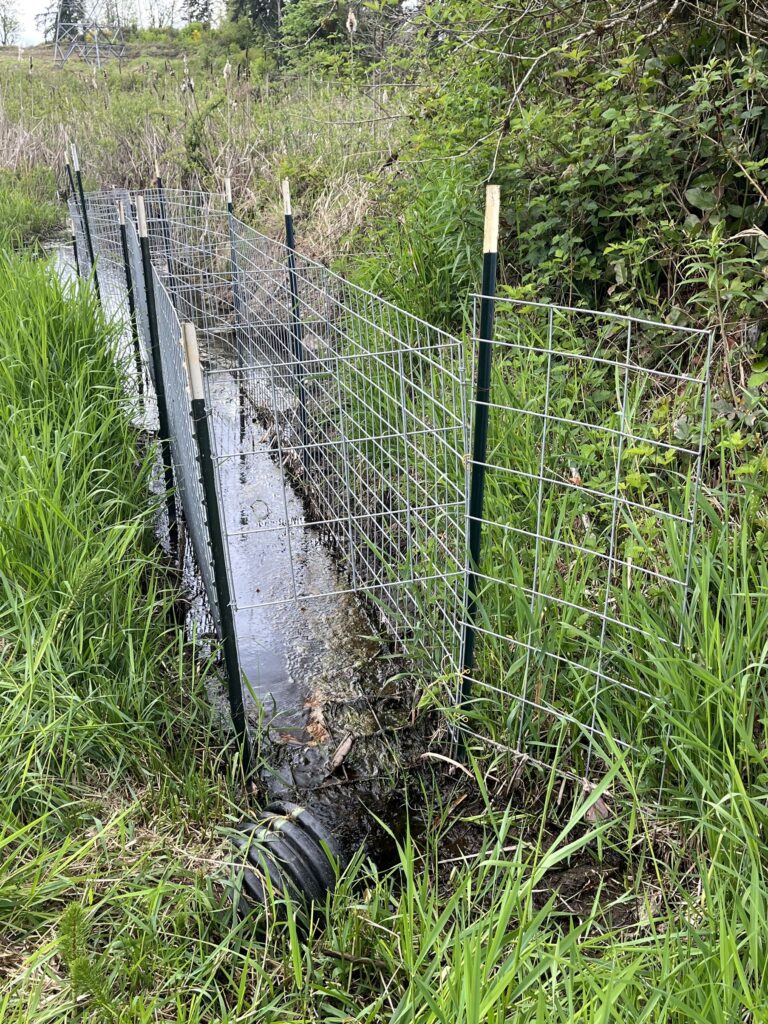
Snohomish County roads SBB in narrow ditch, 2-foot wide. Lower end is open with no attempt at beaver plugging culvert or within lane fence. Fence grid is 6”x8”. Fish can pass through the culvert and SBB.
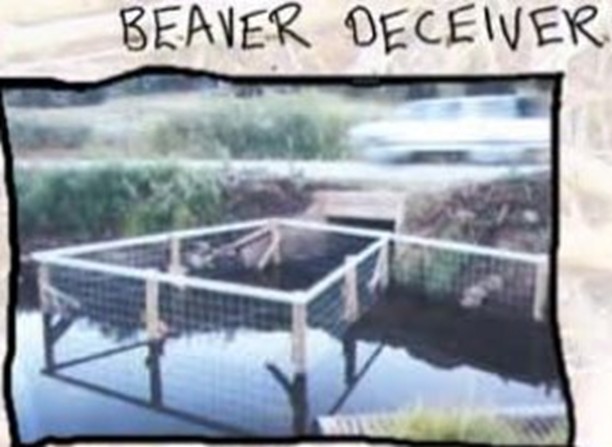
Beaver Deceiver installed in Colorado coordinated by Skip Lisle during early 2000’s with a wing that successfully allowed beaver passage under a busy highway
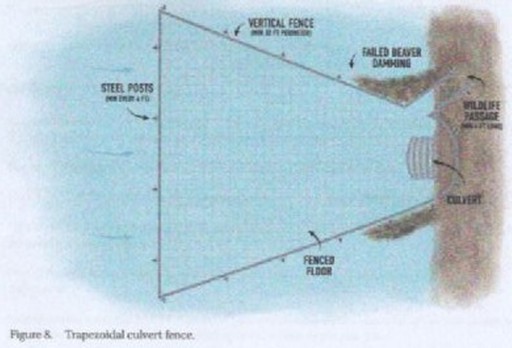
Concept Trapezoid culvert fence with wing for wildlife passage included in BMPs for Oregon Beaver Project.
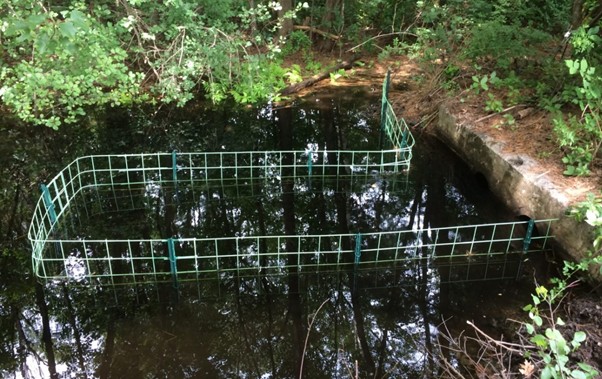
A Beaver Solutions installation that provides wildlife passage similar to the SBB. Beaver Solutions or Beaver Institute do not include any examples or recommendations for wildlife passage options using wings on their websites. This example is from a Beaver Solutions online conference presentation.
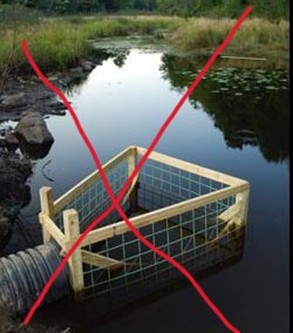
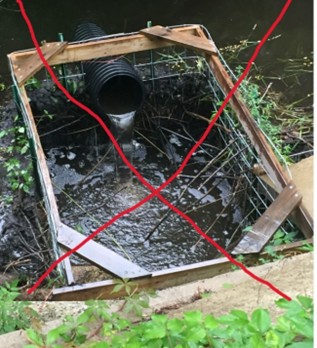
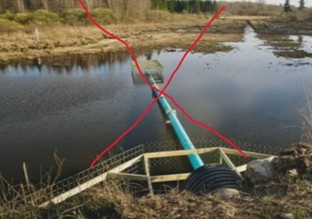
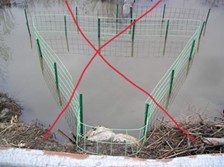
Examples of devices that protect culverts, but also obstruct or block fish/wildlife passage
Beavers, large turtles, and other wildlife passage are blocked by attaching this device to the culvert. The small fence may also encourage beavers to build a dam around the device.
Poor wildlife passage. The small screened area is plugged by debris and beaver working. Beavers are unable to pass through the culvert. Fish are totally blocked from upstream or downstream movement.
A large culvert is being supplied by a small shallow water remote intake. The intake pipe is much smaller than the culvert. No wildlife passage is apparent. Beaver passage through the large culvert under the road is blocked. An SBB device installed in shallow water would easily resolve fish/wildlife passage issues and issues related to the small pipe flow restrictions.
The trapezoidal device is probably effective at keeping beavers away from the culvert, however passage of beavers and wildlife through the culvert is blocked. An SBB device with wings would resolve wildlife passage issues. Small fish passage OK.
Feature 5 – Why pond leveler version of SBB provides Fish passage
Problem: Fish passage can be constricted or blocked by flow-pipe devices that are installed in deep water with a pipe over the dam .
Solution: Fish passage is provided by three features incorporated into the pond leveler version of Stan’s Beaver Baffler. SBB incorporates shallow water installation, a lane fence through the dam notch and right-sized panels to provide fish passage.
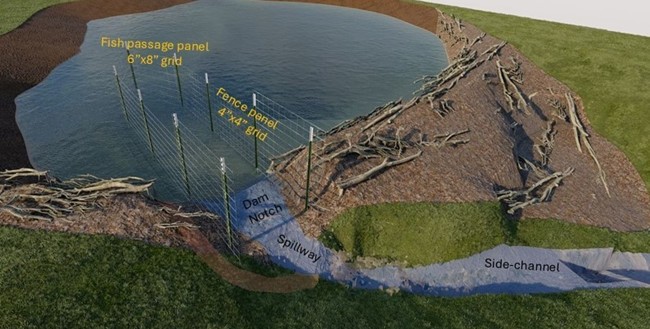
Fish passage is provided by the Pond Leveler version of SBB, solving the problem of flow-pipe systems that constrict or block fish passage.
- Locate the dam notch in shallow water to accommodate use of side-channels that assist fish to bypass large beaver dams.
- a. Small fish migrating downstream are able to easily move through the lane fence and dam notch before returning to the main channel below the dam.
- Large fish moving upstream to spawn benefit because water flow is concentrated through the dam notch and into a side channel.
- Extend a lane fence through the dam notch to include fast moving water in the spillway.
- Beavers live and build their dams where water is slow moving. They build and maintain their dam by floating material to the dam, then adding it to the top of the dam or pushing it over the dam from the pond side of the dam.
- Beaver instinct is to avoid building dams in fast flowing water with a steep gradient.
- Beaver also avoid attempting to repair water leaks on the downstream lower portions of an established dam.
- The combination of avoiding fast moving water and avoiding repairing leaks on the down slope portion of a dam will discourage beaver from attempting to dam water flowing through the dam notch, spillway, and side channel.
- The utilization of right-sized fish passage panels on the upper portion of the SBB allows fish to exit the SBB lane fence.
- Beavers may attempt to rebuild their dam on the pond side lane fence but will typically give up after damming 4-6 feet upstream from the dam with no results. Some pruning of material within the lane fence poked through by beavers may be needed for a short time period until the beavers give up. No need to remove small amounts of material placed on the outside of the lane fence by beavers if upper panels are still providing water into and through the SBB.
Examples of installations that protect pond levelers utilizing shallow water dam notches, lane fences with spillways and livestock panels to accommodate fish passage.
Note: Some of the examples shown are preliminary concept and may not have all of the features described for the pond leveler version of the SBB.
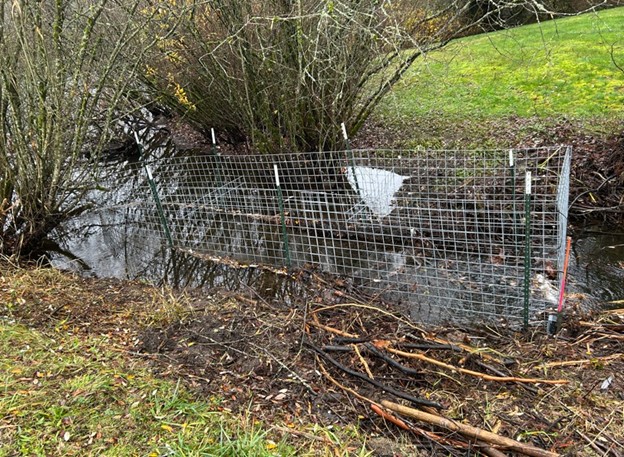
A notch exclusion device (NED) through a small beaver dam. Dam was rebuilt by beaver outside of NED. No building within the NED or attempts to build against the fence below the dam.
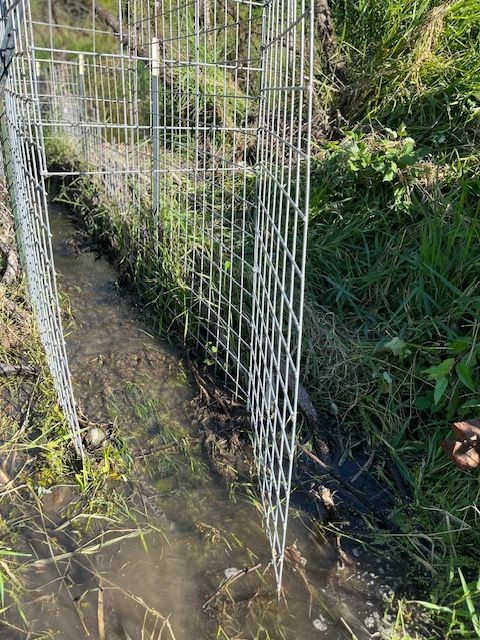
Lane fence extended 12-feet below dam notch. Fence had a gate to close access for several months, then opened. No attempt by beavers to access and rebuild the dam from below. Fish access is available through the lane fence and dam notch during high water flows.
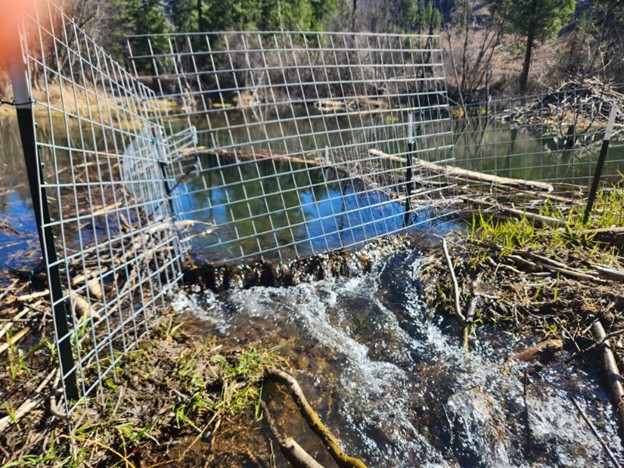
Notch Exclusion Device (NED) installed in small dam. Lower end of the NED not enclosed. Some beaver damming attempts against the fence. Beaver bypass the NED over the dam. No attempt to enter the NED and rebuild the dam at the original site.
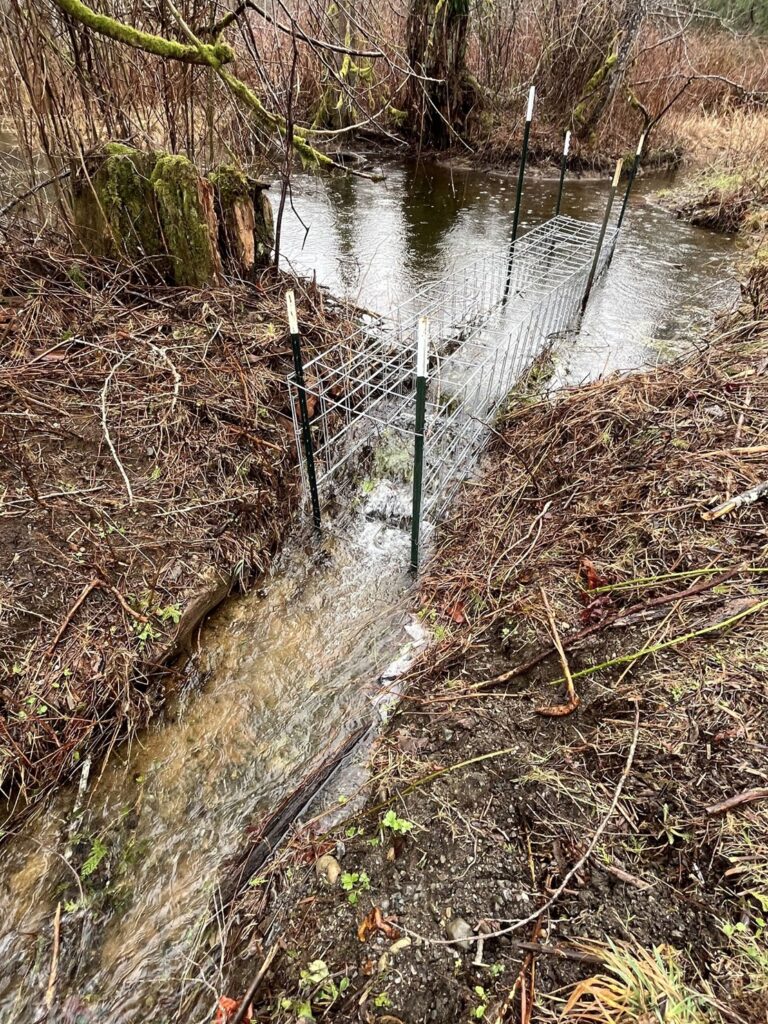
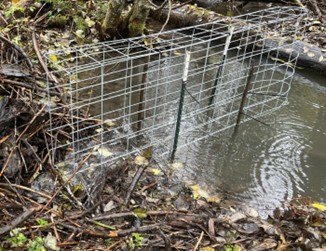
Small narrow NED installed in small dam. Lower end of the NED not enclosed. Beaver bypass the NED over the dam. No attempt to enter the NED and rebuild the dam at the original site.
Missouri
Beaver dam created across a lake dam outlet. Small Beaver Baffler with enclosed lower end installed. Dam notch about 12-feet wide.
Integral skirt created. Fence was 2”x4” woven wire
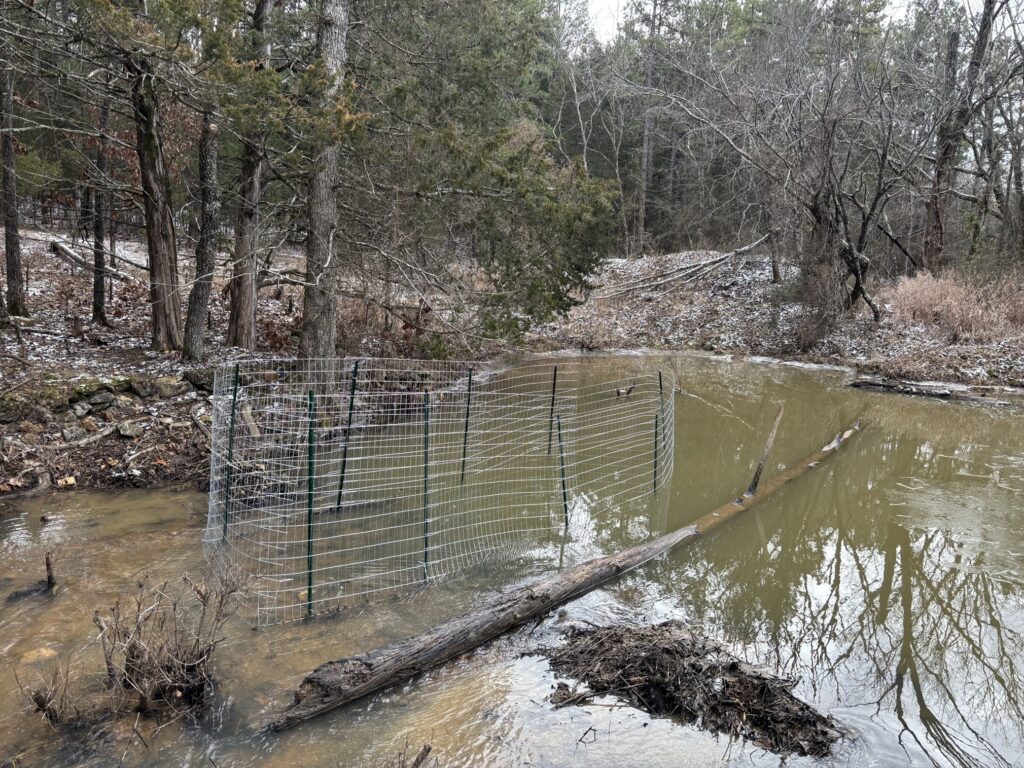
Beaver rebuilt dam against the fence at original dam location. Beaver avoided building against the fence below the original dam site.
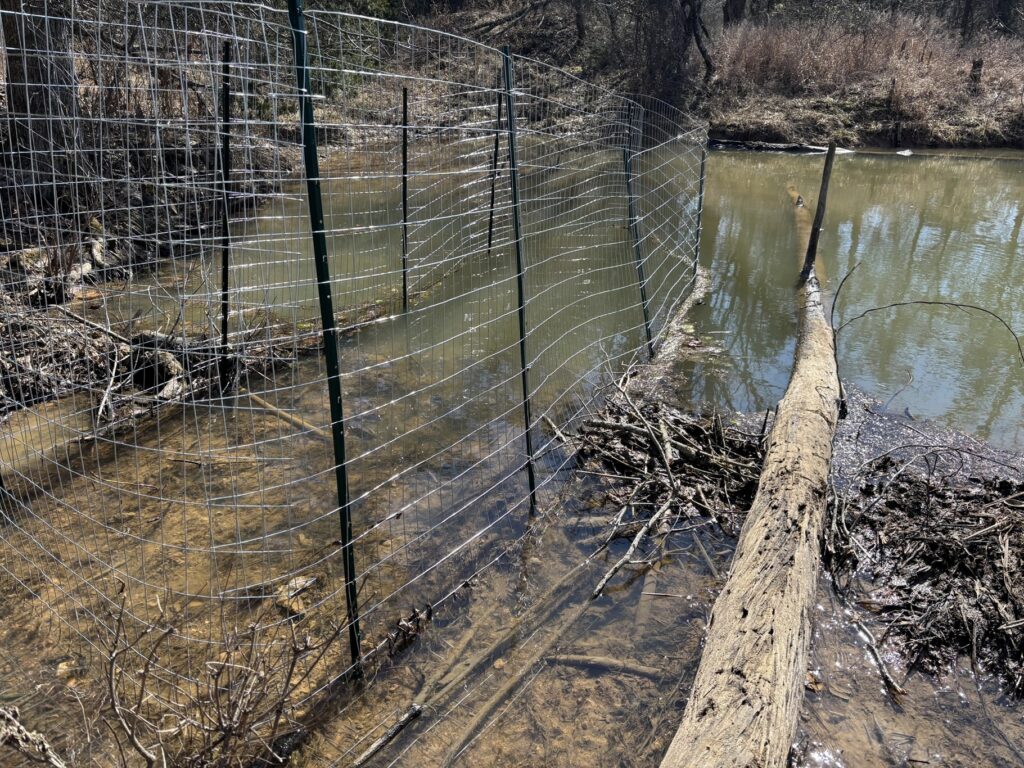
Stan’s Bever Baffler is installed with a gate. Beaver built against the fence on the pond side of dam. Some material added to top of dam. No attempt to rebuild from spillway portion of installation.
Examples of devices that protect dam notches but also obstruct or block fish passage when water flow is directed through long flow-pipe with a deep water intake.
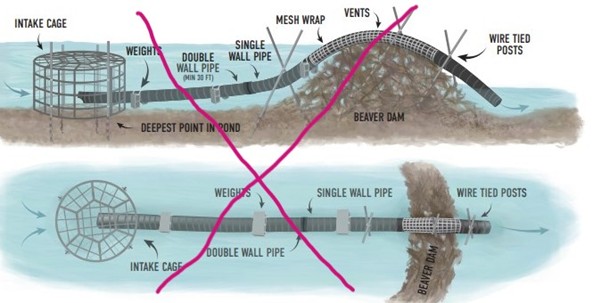
Fish passage difficult if not impossible.
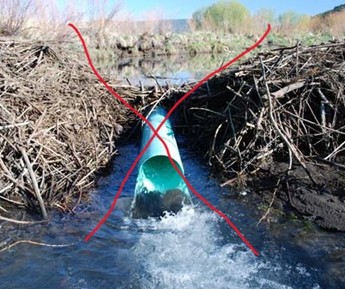
Fish passage difficult if not impossible.
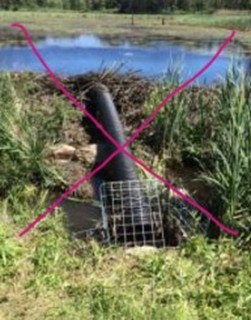
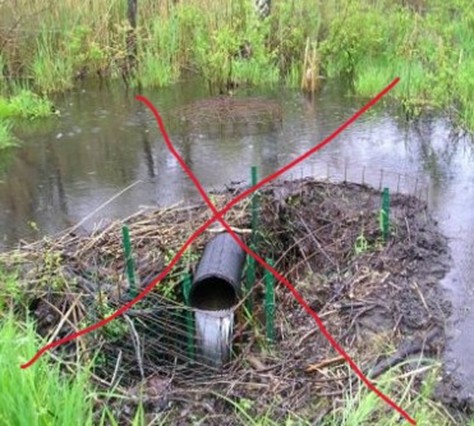
Pond level has been stabilized with flowpipe system. However, fish passage over dam fence or through culvert flowpipe difficult or impossible.
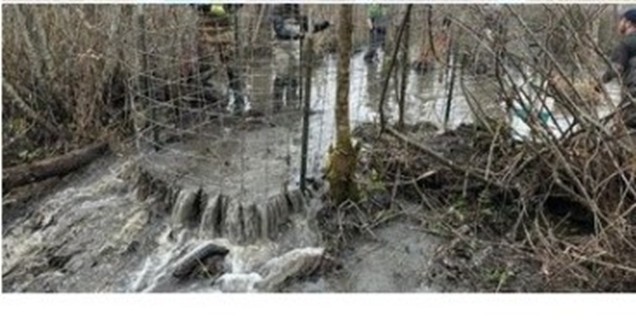
Notch Exclusion Device (NED). Beaver appear to rebuild a dam against the lane fence where the original dam occurred. No beaver activity against the lane fence below the original dam. Water level is elevated because of debris collecting on the wire fence inside the lane fence where water exits, creating a debris dam. The debris dam elevates the water level and may constrict fish passage.
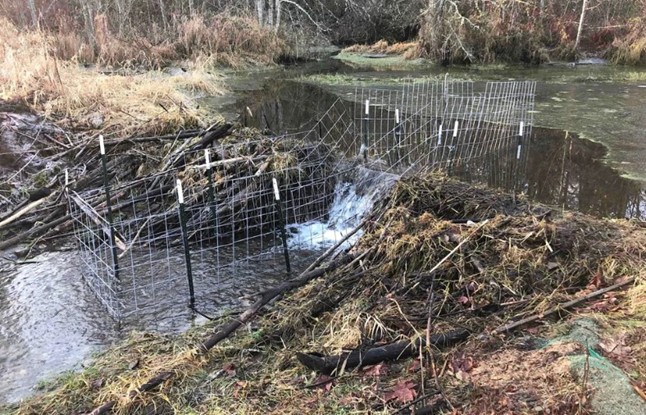
Notch Exclusion Device (NED) installed in the middle of the dam which extends into deep water of pond. Installation in the middle of the dam results in a high spillway with waterfall and potential fish passage constrictions. An SBB Installation at the edge of the dam would allow use of a side channel, instead of a waterfall, which better accommodates fish passage.